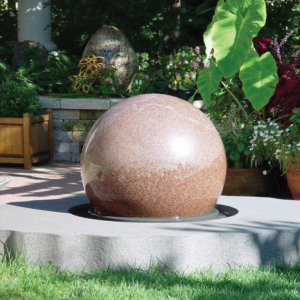
Floating Granite Ball Fountain Engineered by Hydro Dramatics
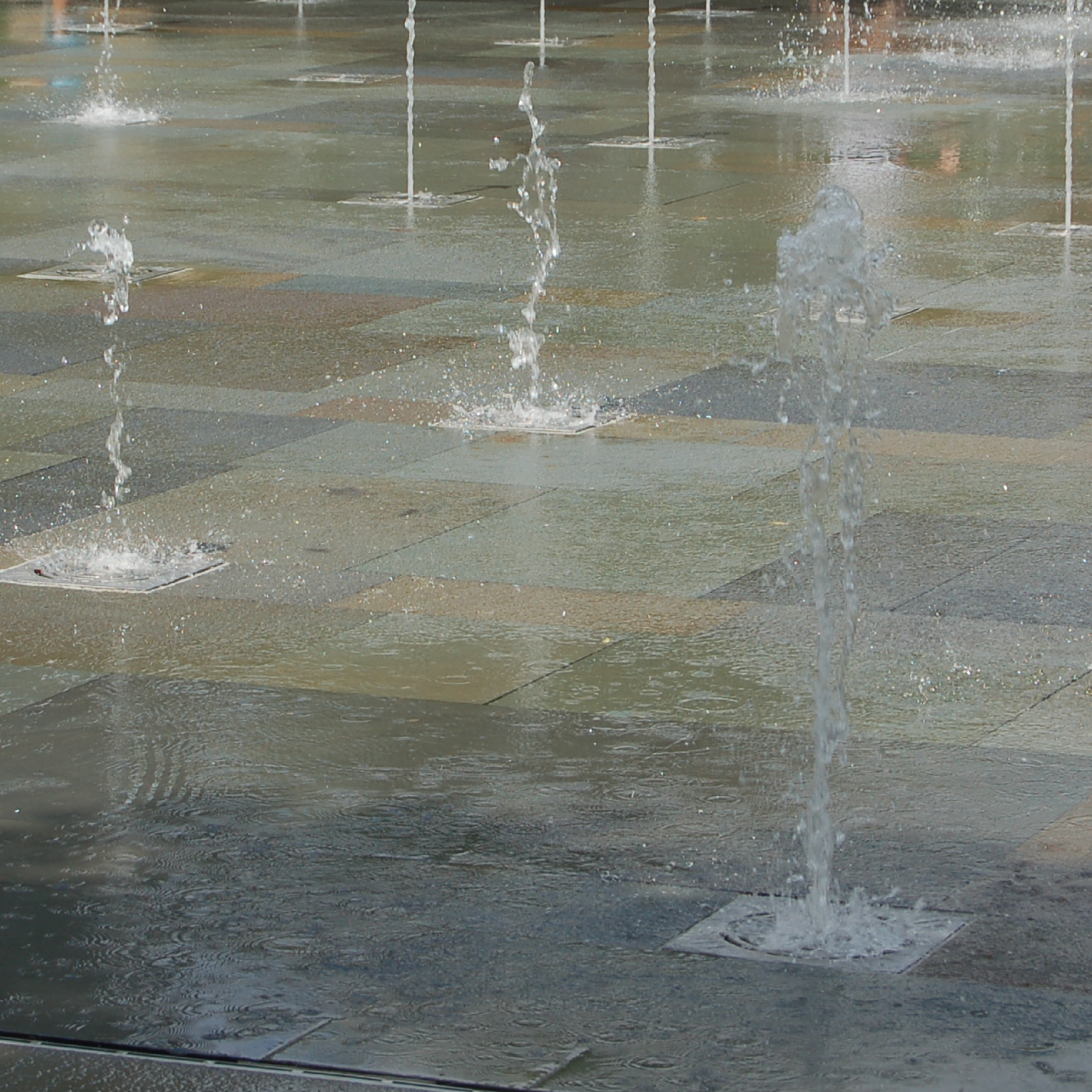
Citygarden architectural water feature and custom fountain engineering
Hydraulic Precision & Architectural Mastery

Floating Granite Ball Fountains: B2B Engineering & Procurement Specification Guide

How hydrostatic lift physics, micrometric sphere machining, and integrated vault systems create landmark kinetic water sculptures worldwide.

±0.05 mmSphericity Tolerance
15–45 PSIHydrostatic Lift Pressure
40+ YearsDivision Engineering Legacy
100% CustomPre-Fabricated Mechanical Vaults
Engineering Whitepaper & Technical Analysis

Hydrostatic Physics & Precision Machining of Floating Granite Ball Fountains

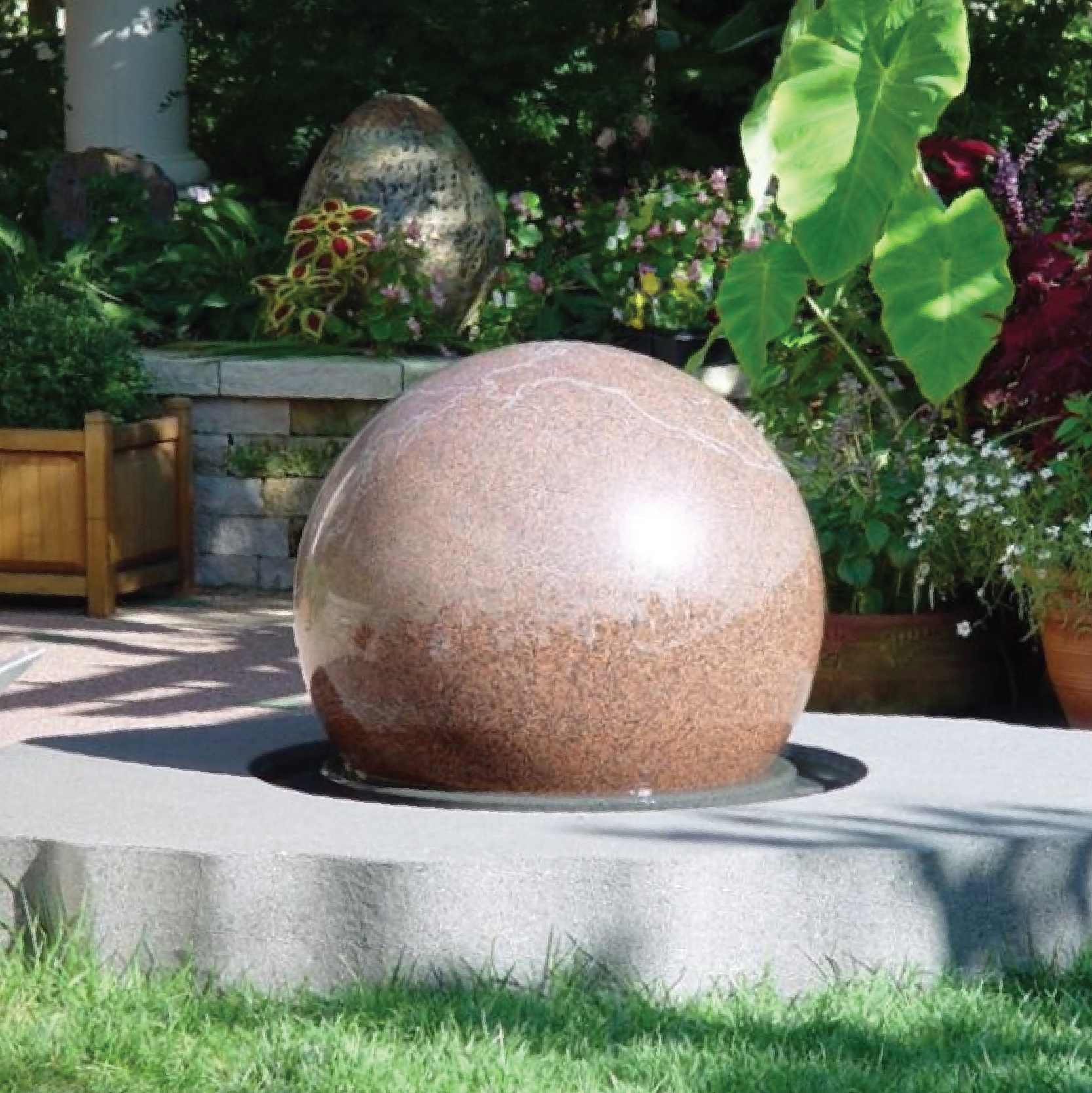
Floating Granite Ball Fountains—often referred to in civil engineering and landscape architecture as Kugel Fountains (derived from the German word Kugel meaning sphere)—represent one of the most mesmerizing intersections of fluid dynamics, classical stone craftsmanship, and mechanical engineering. To the untrained observer, a solid granite sphere weighing anywhere from 1,000 lbs to over 30,000 lbs (450 kg to 13,600 kg) appears to float effortlessly atop a concaved stone socket, spinning smoothly at the touch of a child's hand. However, beneath this effortless kinetic motion lies a hyper-precise balance of hydrostatic film pressure, micrometric dimensional tolerances, structural load management, and closed-loop filtration science.

At Hydro Dramatics, a specialized division of Missouri Machinery & Engineering Co., we have spent over four decades translating complex fluid mechanics into reliable, low-maintenance architectural water features across North America and around the globe. This guide provides architects, structural engineers, municipal procurement directors, and landscape contractors with an exhaustive breakdown of how commercial floating granite sphere fountains function, how to specify them correctly, and how upcoming technological innovations are reshaping global procurement trends.

Information Gain Spotlight: Pascal's Principle & Fluid Lubrication Film

A floating granite sphere does not float because of turbulent high-velocity water jets pushing it upward. Instead, it relies on Pascal’s Law of Hydrostatic Pressure and dynamic liquid film lubrication. Water is pumped into a custom-machined concave socket matching the exact radius of curvature of the sphere. As pressurized water enters the sealed cavity beneath the sphere, it cannot escape without lifting the stone ball. Once the upward hydraulic force exceeds the gravitational downward force of the sphere's mass, a continuous micro-thin film of water—typically between 0.1 mm and 0.3 mm (0.004" to 0.012") thick—forms beneath the ball. This liquid layer eliminates all stone-to-stone friction, allowing the massive sphere to rotate multi-axially with minimal tangential resistance.

Granite Selection, Sphericity Tolerances, and Machining Physics

The operational success of a floating granite ball fountain hinges fundamentally on two non-negotiable manufacturing criteria: absolute granite material homogeneity and micrometric sphericity tolerance.

  • Material Homogeneity & Density: Only dense, non-porous granite grades with uniform crystal structure are suitable for floating sphere applications (e.g., Absolute Black, Imperial Red, Sesame White, or Tropical Green granite). The stone block must be free of micro-fissures, quartz veins, or density variations. Variations in internal density alter the sphere's center of gravity, causing the ball to wobble off-axis or tilt prematurely in the socket, which breaches the pressurized fluid seal.
  • Micrometric Sphericity Tolerance: Standard monumental stone turning equipment cannot achieve the tolerances required for hydrostatic floating. High-precision CNC spherical grinders and diamond-lap polishing systems must craft the sphere to a sphericity tolerance within ±0.05 mm (50 microns) across the entire circumference. If a 1,200 mm diameter sphere is out-of-round by even 0.1 mm, the water film thickness will become uneven, causing high-pressure fluid leakage at wider gaps and localized mechanical rubbing at narrow points.
  • Socket Radius Matching: The receiving stone pedestal or socket basin must be diamond-milled to mirror the sphere’s exact curvature radius. The contact arc of the socket typically covers between 35° and 45° of the sphere's lower hemisphere. A socket that is too shallow will fail to contain the required hydrostatic pressure envelope; a socket that is too deep creates excessive surface drag and restricts interactive rotational freedom.
Sphere Diameter (mm / in) Approximate Weight (kg / lbs) Required Hydrostatic Lift Pressure Minimum Recommended Flow Rate Ideal Socket Concavity Arc
600 mm / 24" 310 kg / 680 lbs 12 – 18 PSI (0.8 – 1.2 bar) 25 – 40 GPM (95 – 150 LPM) 42° - 45° radius arc
1,000 mm / 40" 1,420 kg / 3,130 lbs 18 – 26 PSI (1.2 – 1.8 bar) 55 – 85 GPM (210 – 320 LPM) 40° - 42° radius arc
1,500 mm / 60" 4,780 kg / 10,530 lbs 28 – 38 PSI (1.9 – 2.6 bar) 110 – 160 GPM (415 – 605 LPM) 38° - 40° radius arc
2,000 mm / 80" 11,300 kg / 24,900 lbs 35 – 48 PSI (2.4 – 3.3 bar) 200 – 290 GPM (755 – 1100 LPM) 35° - 38° radius arc

*Note: Technical values represent baseline hydraulic engineering parameters. Specific pump total dynamic head (TDH) and pressure requirements vary based on piping length, elevation rise, manifold resistance, and custom socket seal design engineered by Hydro Dramatics.*

Product & Systems Portfolio

Floating Granite Ball Fountain Recommendations & Configurations

Hydro Dramatics designs, engineers, and supplies complete floating sphere fountain packages, tailored to the specific functional and visual goals of commercial developments, public parks, educational institutions, and corporate headquarters.

1. Public Plaza & Urban Redevelopment Series

Sphere Diameters: 1,000 mm to 1,800 mm

Designed for heavy foot traffic, high civic engagement, and dynamic visual impact. These systems feature reinforced, high-durability granite spheres mounted on custom-carved pedestal bases. Often paired with surface-level flush drain channels, perimeter seating ledges, and child-safe low-voltage LED accent lighting.

Best Suited For: Municipal plazas, botanical gardens, public transit hubs, and civic memorials.

2. Interactive Educational & Map-Etched Spheres

Sphere Diameters: 800 mm to 1,500 mm

Leveraging high-precision laser micro-etching, these granite spheres are engraved with detailed world maps, continental topography, astronomical constellations, or historical narratives. As the sphere rotates smoothly on its water film, visitors can physically touch and turn the earth or stars.

Best Suited For: Science centers, university campuses, museum courtyards, and international corporate plazas.

3. Corporate & Luxury Commercial Entrance Features

Sphere Diameters: 600 mm to 1,200 mm

Sleek, mirror-polished granite spheres (often in Jet Black, Emerald Pearl, or Ruby Red) integrated into raised reflection pools or cascading stepped water basins. Optimized for whisper-quiet hydraulic operation, creating an executive ambiance with zero water splashing.

Best Suited For: Luxury hotel lobbies, financial headquarters, healthcare facilities, and high-end residential towers.

4. Multi-Sphere Synchronized Water Sculptures

Sphere Diameters: Multi-ball arrays (e.g., 3 to 7 spheres ranging from 500 mm to 1,000 mm)

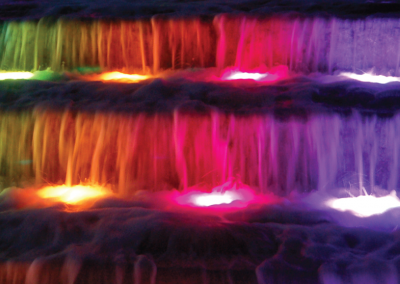
Architectural installations featuring multiple floating granite spheres operating off a centralized, automated hydraulic manifold vault. Each sphere can be engineered to rotate at varying speeds or directions, paired with programmable dynamic water jets and RGBW submersible lighting.

Best Suited For: Landmark entertainment districts, shopping destinations, and mega-scale master-planned communities.

Integrated Hydraulic Equipment Vaults & Filtration Systems

A floating granite ball fountain cannot operate reliably without specialized mechanical backing. Because the fluid film gap between the ball and socket is smaller than a grain of sand (approx. 150 microns), unfiltered debris, scale, or bio-film will cause abrasive scoring on the polished socket, leading to pressure loss and rotational failure.

Hydro Dramatics engineers turn-key, pre-fabricated underground equipment vaults housing:

  • Multi-Stage Micron Filtration: Dual high-rate sand or stainless-steel cartridge filters that trap particulates down to 5–10 microns.
  • Variable Frequency Drive (VFD) Pumps: Commercial bronze or stainless-steel centrifugal pumps with precision VFD controls, allowing fine-tuning of hydrostatic lift pressure to within ±0.5 PSI.
  • Automated Chemical & UV Sanitization: In-line UV sterilizers and automated pH/ORP dosing systems to eliminate algae, bio-fouling, and calcium scaling.
  • Redundant Water Level & Pressure Telemetry: Automatic water makeup, low-water cutoff switches, and dynamic pressure transducers tied into your Building Management System (BMS).
Precision Machined Floating Granite Ball Fountain

Precision Sphere Machining

Each granite sphere undergoes 120+ hours of CNC grinding and hand-polishing to guarantee a mirror finish and micro-inch roundness required for friction-free hydrostatic flotation.

The Hydro Dramatics Authority

Why Leading Architects & Engineers Partner With Us

Designing a floating granite ball fountain involves far more than simply ordering a carved stone sphere from an overseas quarry. Without precise hydraulic sizing, robust mechanical vault engineering, and custom socket machining, projects frequently suffer from catastrophic lockup, water loss, pump burnout, or safety liabilities.

For more than 40 years, Hydro Dramatics has been the premier custom fountain design and engineering firm in the United States. As a dedicated division of Missouri Machinery & Engineering Co. in St. Louis, Missouri, we bring unmatched heavy-machinery engineering discipline to architectural water art.

In-House Mechanical Engineering

Our team consists of licensed mechanical and hydraulic engineers who calculate exact head pressures, flow velocities, structural dead/live loads, and pipe friction losses customized to your project’s exact geographic and spatial constraints.

Custom In-House Fabrication

Unlike distributor companies that resell off-the-shelf components, our division direct-fabricates custom stainless-steel manifold assemblies, socket water inlets, filtration packages, and pre-wired UL-listed control panels under one roof.

Proven Global Project Portfolio

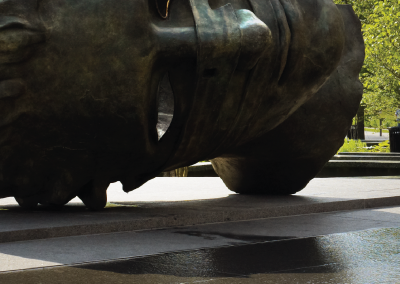
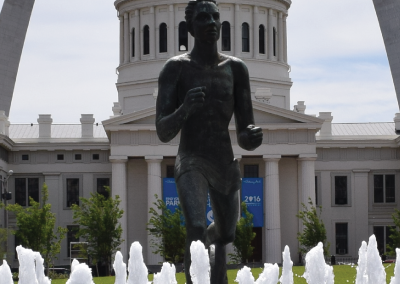
From civic landmarks like Citygarden in St. Louis, Smale Riverfront Park in Cincinnati, and America the Beautiful Park in Colorado Springs to international commercial developments, our systems are proven to operate reliably for decades.

Mastery of Water Pressure & Stone Mechanics

From initial hydraulic schematic design to global site commissioning, we ensure your floating granite sphere fountain performs flawlessly on opening day and for generations to come.

B2B Procurement & Technical FAQ

Frequently Asked Questions by Global Buyers & Engineers

Answers to complex technical, structural, hydraulic, and maintenance questions frequently asked by project managers, architects, and procurement officers when evaluating floating granite ball fountains.

Floating a 2,000 kg (4,400 lb) granite sphere does not rely on high-velocity water jets, but rather on uniform hydrostatic lift pressure spread evenly across the concave socket basin. For a sphere of this mass (typically around 1,150 mm in diameter), continuous socket pressure between 20 PSI and 28 PSI (1.4 to 1.9 bar) is required. The flow rate generally ranges between 70 GPM and 100 GPM (265 to 380 LPM). The critical factor is maintaining a constant fluid film thickness of 0.15 mm to 0.25 mm. Hydro Dramatics sizes pumps with Variable Frequency Drives (VFDs) to allow precise field calibration of this pressure threshold.

Contact Us for precise hydraulic calculations tailored to your sphere weight and pipe runs.

Debris entering the socket cavity is the single greatest operational hazard for kugel ball fountains. Because the fluid clearance gap is micrometric, even fine windblown sand or calcium scale can act as an abrasive lap, gouging the socket and causing pressure loss. Hydro Dramatics mitigates this through a multi-barrier filtration design: custom dual strainers, high-efficiency commercial sand/cartridge filters rated down to 5–10 microns, automated chemical anti-scaling injection, and secondary suction sumps. Additionally, socket inlet ports feature protective internal geometry to prevent particle ingress during pump shutdown.

When installing a large floating granite sphere fountain on an elevated plaza deck, parking garage roof, or interior floor slab, structural engineers must account for three distinct weight components: 1) The static dead load of the solid granite sphere and carved pedestal base (which can exceed 15,000 lbs for a 1.8m sphere); 2) The operational water weight within the basin and underground surge reservoir; and 3) Dynamic hydrostatic thrust load generated by pressurized water beneath the socket. Hydro Dramatics provides complete reaction force vectors, structural weight breakdowns, and wet weight specifications to your structural engineering team during schematic design.

In cold northern climates, water trapped between the sphere and the concave socket socket basin will freeze, expand, and potentially crack the stone socket or lift assembly if not properly engineered. Systems engineered by Hydro Dramatics for cold regions incorporate automated freeze-protection protocols. These include temperature-triggered continuous low-flow recirculation, automated motor-actuated winter drain valves that flush the socket cavity into the underground vault, and optional submerged heating elements within the basin manifold.

Yes! In fact, tactile public interaction is one of the chief design advantages of a floating granite ball fountain. Because the sphere is supported entirely by a pressurized water film, there are zero mechanical gears, drive shafts, or pinch points. The ball can be easily rotated in any direction by a child or adult. If a person applies heavy manual force or holds the ball stationary, the hydrostatic film simply shifts dynamically around the sphere without causing pump strain or structural instability.

Only Grade-A commercial granite with an ultra-low water absorption rate (under 0.2%), high compressive strength (exceeding 200 MPa / 29,000 PSI), and uniform bulk density (typically 2.6 to 2.8 g/cm³) should be specified. Porous stones, marbles, or granites with heavy vein structures must be avoided because water under pressure can penetrate micro-pores, causing internal fracturing during freeze-thaw cycles or degrading the sphere's perfect roundness over time.

Custom floating granite ball fountains, including stone selection, CNC spherical grinding, hand polishing, hydraulic manifold testing, and pre-assembled vault construction, typically carry a manufacturing lead time of 12 to 16 weeks from approved shop drawings. All sphere assemblies undergo rigorous factory hydro-testing at our Missouri facility—verifying rotation stability, lift pressure, and sphericity tolerances—prior to export packaging in reinforced custom wooden crating.

Hydro Dramatics Headquarters

  • Address: 4981 Fyler Ave., St. Louis, MO 63139, USA
  • Phone: +1 314-231-9806
  • Email: [email protected]

Architectural Fountain Projects

View All Projects »