
Choosing among the Top 10 Municipal Park Fountains for Global Buyers requires more than attractive photographs. A successful fountain must serve people, landscapes, budgets, and long-term maintenance plans. It should welcome children, frame civic events, and remain safe during crowded summer evenings. Lawrence Halprin, a renowned landscape architect and fountain designer, wrote, “The fountain is the heart of the city.” His observation still feels practical today.
This guide examines Municipal Park Fountains through a buyer’s lens. We compare water effects, basin design, accessibility, lighting, controls, energy use, and installation demands. A misting plaza may suit a hot public square. A formal cascade may better complement historic gardens. Stainless steel can resist heavy use, but poor detailing still creates stains and difficult repairs. Quiet systems matter near libraries and residential streets. They matter more than glossy renderings.
There is no perfect fountain. Not even close. Local climate, water quality, vandalism risks, and available technicians can change the final decision. A spectacular feature may become expensive if filters clog weekly or replacement pumps require overseas shipping. Some rankings also overlook winterization and inclusive access. That is a weakness worth admitting. Our selection therefore favors credible performance over novelty, using practical criteria that municipal teams, developers, and international buyers can verify. These ten fountains represent different scales and design philosophies, helping readers identify a suitable model rather than chase a universal bestseller.
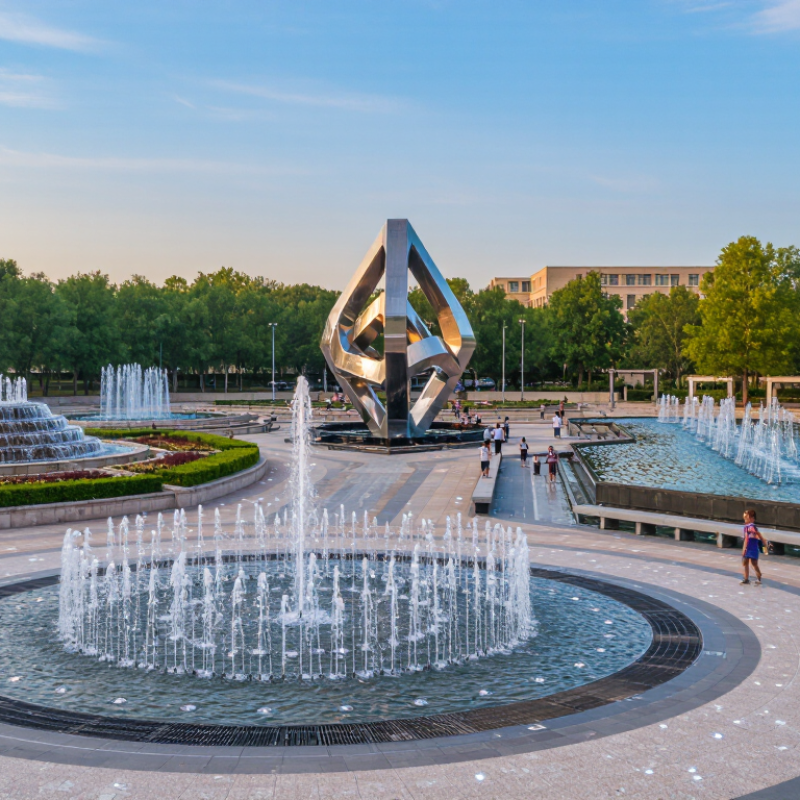
A municipal park fountain is more than a decorative water feature. It is public infrastructure, designed for safety, access, durability, and responsible operation. Its definition includes the basin, pumps, filters, controls, drainage, lighting, and maintenance plan. In practice, the fountain should suit local climate, visitor volume, water quality, and available technical skills.
The CDC’s Model Aquatic Health Code recommends risk-based monitoring for interactive water features, including disinfectant and pH control. This matters when children touch, splash, or accidentally swallow the water. The U.S. Environmental Protection Agency reports that WaterSense products use at least 20% less water than standard alternatives. Municipal buyers should therefore examine nozzles, leak detection, recirculation, and automatic shutdown systems. The design may look simple. The operating system is not. A beautiful basin can still become an expensive maintenance problem.
Tips: Ask for measured flow rates, seasonal energy use, pump access, cleaning intervals, and spare-part availability. Check accessibility around the basin, including stable walking surfaces and clear reach zones. WHO recreational-water guidance also supports preventive risk management, not occasional testing alone. I would not assume recycled water is automatically suitable; treatment quality and local approval still matter. Leave room for human error, because real parks are rarely as controlled as drawings.
Top 10 Municipal Park Fountains for Global Buyers
Key selection criteria matter more than visual drama. A top-ten municipal fountain should fit local climate, public use, and maintenance capacity. UN DESA projects that 68% of people will live in urban areas by 2050. This increases demand for durable, inclusive public spaces. Buyers should examine water treatment, slip resistance, lighting safety, accessibility, and noise levels. The WHO Guidelines for Safe Recreational Water Environments recommend risk-based water management, not occasional testing alone. Ask for documented filtration results and cleaning procedures.
Lifecycle cost deserves careful attention. UN-Water reports that agriculture uses about 70% of global freshwater withdrawals. Decorative fountains should therefore prioritize recirculation, leak detection, rainwater integration, and adjustable pump controls. Energy-efficient motors can reduce operating costs, but performance claims need independent test records. Check spare-part availability, corrosion protection, winterization, and remote monitoring. A low purchase price can look efficient. It may not be.
Tips: Request a five-year operating estimate, not only a product quotation. Test water flow during peak visitor hours. Confirm compliance with local electrical, accessibility, and water-safety rules. Use textured paving around splash zones. A perfect fountain does not exist; neglected maintenance can defeat excellent design.
This weighted selection index highlights the criteria that most influence municipal park fountain procurement. The score is based on a 100-point buyer framework covering lifecycle value, public safety, sustainability, accessibility, and operational performance.
Key insight: Lifecycle cost, water efficiency, safety compliance, and climate resilience should receive the highest priority when comparing public fountain projects across different countries and operating environments.
Top 10 Municipal Park Fountain Designs
Municipal fountain design now serves cooling, accessibility, identity, and water efficiency. UN-Habitat’s World Cities Report 2022 states that 56% of people live in urban areas. Public water features therefore need to perform beyond decoration.
The strongest ten designs include the linear rill, circular plaza basin, interactive splash pad, misting arch, stepped cascade, dry deck fountain, sculptural jet wall, reflective pool, solar-powered aeration fountain, and naturalistic stream fountain. A linear rill guides pedestrians through stone paving. A splash pad offers play without deep standing water. A misting arch can cool a queue or seating zone. Dry deck jets disappear into flush grilles, improving event flexibility. Reflective pools create calm visual space, but they demand careful cleaning and slip control.
The U.S. Environmental Protection Agency reports that outdoor irrigation can represent nearly one-third of residential water use. Municipal fountains are different, yet the lesson remains useful: specify recirculation, leak sensors, adjustable nozzles, and timed operation. A 30-minute inspection can reveal cloudy water, blocked drains, or uneven spray. Small details matter.
Designers should also follow local accessibility standards, provide clear maintenance access, and separate wet surfaces from walking routes. I have seen attractive basins fail because maintenance vehicles could not reach their pumps. That mistake is avoidable. Some solar systems perform poorly under seasonal shade, so energy modeling should precede installation. The most impressive fountain is not always the tallest one. It is the one that remains safe, legible, efficient, and welcoming after years of public use.
Top 10 Municipal Park Fountains for Global Buyers: Materials, Technologies, and Maintenance Requirements
Material selection decides a fountain’s service life. For wet, public environments, 316L stainless steel resists chloride corrosion better than standard steel. Dense concrete needs proper sealing, drainage, and movement joints. HDPE piping can reduce corrosion risks, but careless installation may cause leaks. Gaskets should tolerate ultraviolet exposure and repeated chemical cleaning. Small failures become visible quickly.
Modern systems use variable-speed pumps, level sensors, automatic dosing, filtration, and ultraviolet treatment. The CDC’s Model Aquatic Health Code recommends 1–3 mg/L free chlorine and pH of 7.2–7.8 for many aquatic venues. Local rules still control. The UN World Water Development Report 2024 notes that agriculture represents about 70% of global freshwater withdrawals. Therefore, recirculation, rainwater capture, and leak alarms deserve serious consideration. However, recycled water needs verified treatment. “Green” is not automatically safe.
Tips: Specify daily visual checks, weekly strainer cleaning, and documented monthly inspections. Test chlorine, pH, turbidity, pump vibration, and nozzle performance. Keep spare seals and nozzles on site. Design access panels around real maintenance tools, not only drawings. The U.S. EPA WaterSense program identifies leaks as a major source of avoidable water loss, although its household data does not directly represent fountains. That limitation matters. A perfect specification is a myth. Public use, weather, water quality, and operator skill will change the maintenance burden.
| Rank | Fountain Type | Best Municipal Application | Recommended Materials | Key Technologies | Typical Planning Parameters | Maintenance Requirements | Typical Service Frequency | Energy and Water Profile | Important Safety and Accessibility Points | Global Buyer Consideration |
|---|---|---|---|---|---|---|---|---|---|---|
| 1 | Interactive Dry-Deck Fountain | Urban plazas, civic parks, family recreation areas and locations requiring flexible open space. | Slip-resistant granite or porcelain pavers, reinforced concrete basin, 316 stainless-steel nozzles, stainless-steel grilles and UV-resistant joint sealants. | Flush-mounted spray nozzles, variable-speed pumps, programmable LED lighting, water-level sensors, automatic dosing and emergency stop controls. | Nozzle zone commonly 10–30 m long; spray height typically 0.5–2.5 m; concealed balance tank sized for the hydraulic design. | Remove debris from grilles, inspect nozzles, clean filters, test sensors, check paving joints and verify water disinfection. | Daily visual check; weekly cleaning; monthly equipment inspection; seasonal deep service. | Recirculating water system; variable-speed pumping can reduce energy during low-use periods. Makeup water is required for evaporation and splash-out. | Use slip-resistant surfaces, controlled spray pressure, safe drainage, accessible routes and water-quality controls suitable for public contact. | Strong choice where the fountain area must also function as an event space or pedestrian plaza. |
| 2 | Architectural Tiered Fountain | Historic districts, formal gardens, entrance courts and landmark-focused municipal parks. | Natural stone, cast stone, reinforced concrete, 316 stainless-steel pipework and corrosion-resistant bronze or stainless fittings. | Gravity-fed cascades, low-pressure circulation pumps, adjustable weirs, level controls and optional underwater lighting. | Usually 2–5 tiers; individual cascade drops commonly 0.2–0.8 m; basin depth often 0.3–0.6 m where public access is restricted. | Inspect stone joints, remove sediment, clean overflow channels, check pump strainers and repair mineral deposits or surface scaling. | Weekly visual inspection; monthly basin cleaning; quarterly stone and pipework inspection. | Moderate pumping demand because water is recirculated. Gravity-assisted layouts can reduce pump head and operating cost. | Control access to deep basins, provide edge protection where necessary and avoid sharp stone edges or uncontrolled overflow onto walkways. | Best suited to projects where visual permanence and architectural character are more important than interactive play. |
| 3 | Reflecting Pool with Aeration Jets | Memorial parks, government precincts, cultural landscapes and large formal gardens. | Reinforced concrete with waterproofing membrane, dark granite or dense porcelain lining, 316 stainless-steel aeration assemblies. | Low-profile aeration jets, surface skimmers, automatic top-up, circulation filtration and programmable lighting. | Large horizontal footprint; typical water depth 0.2–0.5 m in non-wading designs; jet height commonly 0.3–1.2 m. | Skim leaves, clean filters, control algae, inspect waterproofing, remove sediment and maintain water clarity. | Daily debris removal in leaf seasons; weekly water-quality check; monthly filtration service. | Lower energy than high vertical displays when designed with low-head circulation and modest aeration. Water loss mainly comes from evaporation and wind drift. | Provide clear separation from deep water, safe perimeter paving, effective drainage and protection against stagnant-water conditions. | Requires careful design in hot, windy or dusty climates because evaporation and water-quality demand increase. |
| 4 | Musical and Programmable Show Fountain | Major city parks, tourism districts, waterfront promenades and scheduled public events. | Reinforced concrete, waterproof coating, 316 stainless-steel manifolds and nozzles, marine-grade cable protection and durable access covers. | PLC or show-control system, variable-frequency drives, individually controlled nozzles, RGBW LED fixtures, time-coded audio and remote diagnostics. | Display length commonly 20–80 m; jet heights may range from 2–15 m; equipment room and balance tank require substantial service access. | Clean nozzles and filters, inspect lighting and cabling, calibrate pumps and valves, test control sequences and maintain audio equipment. | Daily operating check; weekly nozzle and filter inspection; monthly electrical and control-system test; annual specialist commissioning. | High peak electricity demand during shows. Efficient scheduling, LED lighting and variable-speed drives can lower annual consumption. Water is normally recirculated. | Use exclusion zones, emergency shutdowns, electrical protection, safe maintenance access and splash management near audiences and electrical equipment. | Suitable for high-visibility destinations, but it has the highest controls, commissioning and spare-parts complexity in this table. |
| 5 | Interactive Mist and Fog Plaza | Hot-climate parks, pedestrian streets, transit plazas and cooling-focused public spaces. | 316 stainless-steel mist lines, corrosion-resistant valve assemblies, slip-resistant paving, reinforced concrete service trenches and hygienic water-contact components. | High-pressure mist pumps, fine mist nozzles, wind and temperature sensors, automatic purge cycles, filtration and programmable zone control. | Mist zones commonly 10–40 m long; nozzle spacing often 0.6–1.5 m; operating pressure depends on nozzle specification and droplet size. | Replace or clean fine filters, descale nozzles, sanitize lines, inspect high-pressure connections and prevent standing water in inactive sections. | Daily nozzle observation; weekly purge and filter check; monthly sanitation and pressure inspection. | Moderate to high pump demand during operation. Water consumption can be higher than closed-loop fountains because mist is dispersed into the atmosphere. | Manage slip risk, aerosol exposure, wind drift and water hygiene. Avoid operation during unsuitable wind conditions or when nearby surfaces become wet. | Most effective in dry, hot environments; it is less suitable for cold or consistently humid climates. |
| 6 | Naturalistic Stream and Cascade | Botanical gardens, ecological parks, woodland landscapes and stormwater-integrated public spaces. | Local stone, reinforced concrete structures, geomembrane liners, stainless-steel intake screens and aquatic-grade sealants. | Recirculation pumps, biological filtration, skimmers, sediment forebays, flow-control weirs and optional ultraviolet treatment. | Watercourse width commonly 1–5 m; shallow flow depth often 0.1–0.4 m; cascade drops typically 0.2–1.0 m. | Remove leaves and sediment, manage aquatic growth, inspect liners and banks, clear intake screens and monitor erosion or blocked flow paths. | Weekly inspection; monthly sediment and vegetation management; seasonal bank and liner review. | Low to moderate energy when topography supports gravity flow. Water losses occur through evaporation, seepage and plant uptake. | Control water depth and access, protect children from slippery banks, prevent stagnant pockets and provide safe maintenance crossings. | Offers strong landscape integration but needs site-specific ecological, hydraulic and seasonal water management. |
| 7 | Perimeter Ring-Jet Fountain | Roundabouts, park entrances, civic forecourts and compact urban landscapes. | Granite or precast concrete basin, 316 stainless-steel ring manifold, stainless nozzles and reinforced concrete foundation. | Ring manifold, adjustable vertical or angled jets, variable-speed circulation pump, level sensor and optional LED lighting. | Typical diameter 4–15 m; jet height commonly 0.5–3 m; basin depth often 0.25–0.5 m in non-wading installations. | Clean the ring manifold, inspect nozzle alignment, remove sediment, service the pump and check perimeter drainage. | Weekly visual cleaning; monthly pump and nozzle inspection; quarterly basin maintenance. | Moderate energy demand with relatively predictable hydraulic loading. Recirculation limits water consumption. | Provide non-slip perimeter paving, prevent spray onto roads or pedestrian routes and secure access covers against unauthorized entry. | A compact, recognizable layout that can be adapted to many climates and site geometries. |
| 8 | Laminar-Flow Jet Fountain | Contemporary parks, hotel-adjacent public spaces, commercial civic areas and decorative pedestrian plazas. | Precision-machined 316 stainless-steel or engineered polymer nozzles, reinforced concrete basin, durable paving and corrosion-resistant pipework. | Laminar-flow nozzles, fast-response solenoid valves, LED illumination, programmable sequencing and fine filtration. | Jet height commonly 0.5–2.5 m; nozzle spacing often 0.3–1.2 m; exact dimensions depend on water quality and desired visual continuity. | Prevent nozzle blockage, maintain fine filtration, descale outlets, verify valve response and keep the basin free from oils and organic debris. | Daily visual check; weekly filter and nozzle inspection; monthly valve and lighting test. | Moderate energy consumption. Fine nozzles require clean water and stable pressure, which may increase filtration and pump requirements. | Control splash onto walking surfaces, use safe electrical separation and provide accessible service covers outside the public path. | Produces crisp, visually controlled water effects but is more sensitive to poor filtration and mineral scaling. |
| 9 | Solar-Powered Decorative Fountain | Remote parks, small plazas, low-infrastructure sites and projects prioritizing renewable-energy demonstration. | UV-resistant photovoltaic mounting components, stainless-steel pump and nozzles, reinforced basin, waterproof electrical enclosures and durable liner materials. | Photovoltaic panels, battery storage or direct-drive pumping, charge controller, low-voltage LED lighting and automatic low-water shutdown. | Small to medium display; jet height commonly 0.3–1.5 m; photovoltaic capacity must be calculated from pump load, operating hours and local solar conditions. | Clean panels, inspect batteries where used, clear pump intake, check wiring and maintain water quality in the recirculating basin. | Weekly visual inspection; monthly pump and panel cleaning; seasonal battery and electrical-system check. | Low grid dependence, but output varies with solar irradiance. Battery systems add replacement and end-of-life management requirements. | Protect electrical equipment from water ingress, secure panels and batteries, provide safe low-voltage distribution and prevent public access to service components. | Best for modest water displays; large show effects generally require grid power or a hybrid energy system. |
| 10 | Drinking-Water Fountain and Bottle-Fill Station | Sports parks, playgrounds, walking trails, transit-connected parks and high-use recreational facilities. | 304 or 316 stainless-steel body, lead-free plumbing components, vandal-resistant fixtures, frost-resistant valves where required and concrete foundation. | Push-button or sensor activation, bottle filler, water filter, pressure regulator, drain connection, temperature-resistant components and optional usage monitoring. | Accessible spout height commonly designed around local accessibility standards; provide clear floor space and suitable drainage around the unit. | Flush lines, sanitize outlets, replace filters, inspect backflow protection, test water temperature and repair leaks or vandal damage. | Daily or high-frequency inspection in busy parks; scheduled sanitation; filter replacement according to water quality and manufacturer requirements. | Very low energy demand when using mains pressure. Refrigerated units require additional electricity and maintenance. | Meet local potable-water, backflow-prevention, accessibility, drainage and hygiene requirements. Use non-contact surfaces where public-health policy favors them. | A practical public amenity rather than a decorative display; local drinking-water regulations govern material and maintenance choices. |
A credible top-ten shortlist should begin with compliance, not appearance. International buyers should request material certificates, electrical test reports, pump curves, and maintenance instructions. Stainless steel should match local water chemistry and corrosion exposure. ISO 12944-5:2018 classifies protective coating environments, helping buyers specify finishes for coastal or industrial parks. Small details matter. A hidden drain can prevent slippery paving.
Water treatment requires careful interpretation. The World Health Organization’s Guidelines for Safe Recreational Water Environments recommends risk-based monitoring for public water features. Local authorities may impose stricter limits for microbial control, chemical storage, and public access. Buyers should confirm backflow protection under EN 1717 or equivalent national rules. Imported equipment may fit physically but fail local certification.
Installation planning often decides project success. The U.S. Department of Energy reports that LED lighting can use at least 75% less energy than incandescent lighting, supporting efficient nighttime displays. However, pumps, filtration, controls, and lighting should be assessed as one system. Specify voltage, frequency, enclosure ratings, spare parts, and commissioning support before purchase. Allow space for filter removal. This is frequently underestimated. A realistic lifecycle budget should include water replacement, winterization, cleaning, and technician training. Some specifications still overvalue spectacle and undervalue access.
Assess climate, visitor use, maintenance skills, water safety, accessibility, noise, and energy demand. Visual drama is not enough.
Linear rills guide movement. Splash pads support play. Misting arches cool waiting areas. Dry deck jets allow flexible event use.
316L stainless steel resists chloride corrosion. Sealed concrete needs drainage and movement joints. HDPE piping can reduce corrosion risks.
Use recirculation, leak sensors, rainwater integration, adjustable nozzles, and timed operation. Recycled water still needs verified treatment.
Use filtration, level sensors, automatic dosing, and ultraviolet treatment. Test chlorine, pH, turbidity, and water clarity regularly.
Check it visually each day. Clean strainers weekly. Document monthly inspections. A short inspection may reveal blocked drains or uneven spray.
Request a five-year operating estimate. Include electricity, cleaning, spare parts, winterization, repairs, and labor. A low purchase price may mislead.
Use slip-resistant paving around wet areas. Separate walking routes from splash zones. Confirm local electrical, accessibility, and water-safety requirements.
Access panels must fit real tools. Pumps, filters, seals, and nozzles should be reachable. Attractive designs can fail here.
No. Seasonal shade can reduce performance. Model sunlight conditions before installation. I might underestimate cloudy-site limitations.
This guide explores how Municipal Park Fountains can enhance public spaces through visual appeal, community value, and functional water management. It explains what distinguishes a municipal fountain from private or decorative installations, including its suitability for high-traffic parks, public safety requirements, accessibility, durability, and efficient operation. Global buyers will find practical selection criteria covering fountain scale, water effects, climate resistance, energy use, noise control, lighting, control systems, and long-term maintenance. It also presents ten adaptable design concepts, from interactive splash features and programmable jets to geometric basins, musical displays, naturalistic streams, and low-maintenance recirculating installations.
The guide further reviews suitable materials, filtration systems, pumps, waterproof lighting, automation, cleaning routines, and inspection needs. It concludes with key international purchasing and installation considerations, including technical documentation, shipping, local site conditions, electrical compatibility, water regulations, safety standards, accessibility, spare parts, contractor coordination, and lifecycle costs. Together, these insights help buyers select reliable, attractive, and sustainable fountain solutions that serve communities effectively over time.