
Choosing the Best China Reflection Pool Water Features Suppliers requires more than comparing catalog prices. A reflection pool may look simple, but its performance depends on pump sizing, nozzle accuracy, basin depth, filtration, and installation planning. A quiet courtyard feature can become noisy when the pump is oversized. Small design errors can also disturb the water surface and weaken the mirror effect.
Reliable suppliers should explain their engineering choices clearly. Look for manufacturers with verifiable project experience, detailed drawings, stable stainless steel or stone components, and responsive technical support. Ask about flow rates, energy use, drainage systems, lighting protection, and replacement parts. Factory visits, sample testing, and independent quality inspections can provide stronger evidence than polished product photos. Clear communication matters, especially when shipping large basins or customized structures from China.
No supplier is perfect. A low quotation may exclude installation guidance, controls, or maintenance tools. A famous supplier may still struggle with unusual site conditions. This comparison should therefore examine practical evidence, not promotional language alone. Request recent project references, material specifications, production timelines, and after-sales procedures before making a decision. The best Reflection Pool Water Features supplier should balance visual quality, technical reliability, budget control, and long-term service. That balance is not always obvious. Careful questions reveal it.
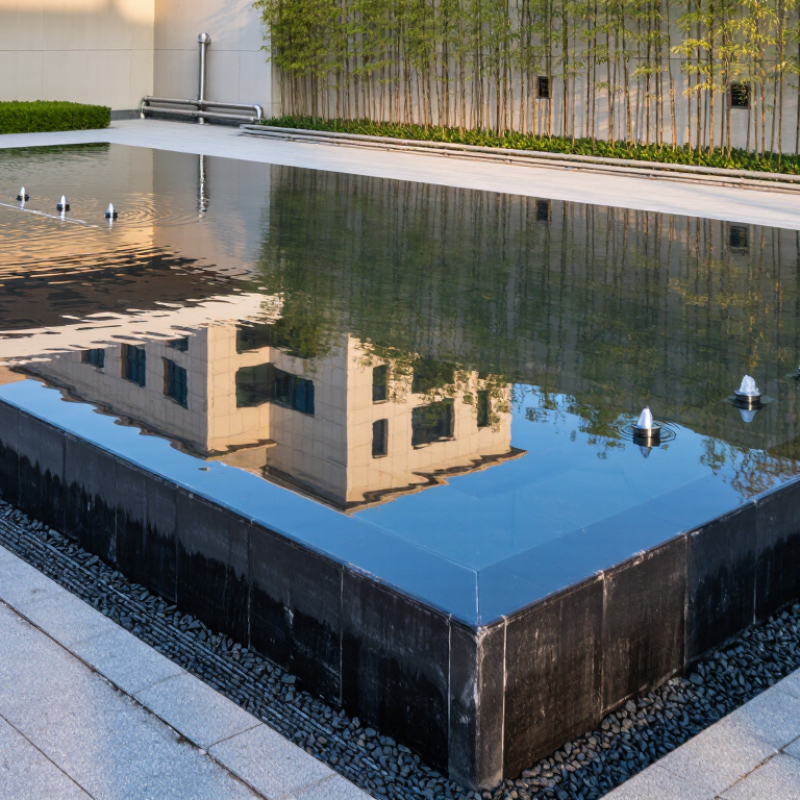
Reflection pool water features are shallow, recirculating water installations designed to mirror architecture, trees, or open sky. They may include a still basin, perimeter overflow, hidden pump, filtration unit, underwater lighting, or gentle jets. The surface should look calm, not busy. That difference matters.
A reflection pool is not simply a decorative pond. Its circulation system controls clarity, algae growth, sound, and operating cost. The CDC Model Aquatic Health Code recommends maintaining free chlorine between 1 and 3 mg/L and pH between 7.2 and 7.8 for treated recreational water. Decorative pools may follow different local rules, but these figures provide a useful technical reference. The U.S. Environmental Protection Agency reports that outdoor irrigation can represent nearly one-third of household water use, making evaporation control important. Covers, automatic level sensors, and correctly sized pumps can reduce waste.
Good suppliers should provide hydraulic calculations, filtration specifications, stone samples, maintenance access, and measured noise data. Ask how the system performs during wind, heat, and heavy rain. A beautiful basin can still fail if its overflow channel is uneven. That is often overlooked. Material selection also needs care: pale stone shows stains quickly, while dark finishes reveal dust and mineral marks. Reliable suppliers explain these weaknesses before installation, rather than promising a flawless surface.
Evaluating Chinese suppliers starts with technical evidence, not attractive photographs. Ask for engineering drawings, pump curves, material specifications, and water-flow calculations. A reliable supplier should explain how the feature controls splash, noise, algae risk, and water loss. Stainless steel grade matters, especially around chlorinated water. Request the exact grade, surface finish, welding method, and corrosion-test records.
Factory experience becomes clearer during a live inspection. Check whether workers measure nozzle alignment, weld penetration, and basin levels. Watch a running sample for at least thirty minutes. Short demonstrations can hide overheating, uneven flow, or excessive vibration. Ask for inspection records, installation manuals, spare-parts lists, and clear warranty terms. These documents reveal technical discipline.
Communication also deserves careful testing. Can the supplier answer questions in drawings and numbers? Vague replies are warning signs. Request independent product testing when local or project standards require it. Confirm electrical protection, pump safety, packaging strength, and export documentation for the destination country. A low quotation may exclude commissioning, drainage changes, or replacement nozzles. That mistake is expensive. One practical weakness remains: remote audits cannot show every production problem. Use staged payments, third-party inspections, and a written acceptance checklist. Test lighting, water clarity, and flow consistency before final shipment.
China’s reflection pool market offers more than simple still-water basins. Available features include bubbling jets, laminar arches, overflow weirs, mist systems, and underwater lighting.
Bubbling jets create gentle movement around stone islands or shallow plazas. Laminar jets produce clear, glass-like streams with controlled arcs. Narrow slot weirs form smooth water curtains along dark granite edges. Overflow channels keep the surface level and visually quiet. Some suppliers also produce custom stainless-steel nozzles for musical or programmable displays. Keep it subtle.
For larger courtyards, multi-level cascades can connect separate reflection pools. Their steps need accurate slopes, sealed joints, and accessible cleaning points. In coastal areas, marine-grade stainless steel helps resist corrosion. Inland projects may prioritize freeze protection and insulated pipework. These details affect maintenance more than appearance.
From project inspections, I have learned that a polished rendering proves very little. Request hydraulic drawings, nozzle flow rates, pump curves, material certificates, and factory testing records. Ask how filters, drains, lights, and control cabinets are replaced after installation. A supplier should also explain water treatment, noise control, and emergency drainage. One weakness remains common: attractive samples sometimes ignore local water quality. Testing a small mock-up before full production can expose splash, glare, or uneven-flow problems early.
The chart compares representative visible water heights commonly used in reflection pool designs. Laminar jets and aerated jets are suitable for precise architectural effects, while cascades, mist systems, and floating nozzles create softer or more dynamic visual experiences. Actual specifications depend on pool size, pump capacity, nozzle configuration, wind conditions, and local safety requirements.
Choosing the best China reflection pool water feature supplier requires more than comparing quotations. Start with quality evidence: stainless steel grade, pump efficiency, welding standards, filtration design, and waterproof testing records. Ask for material certificates and a working sample. A polished photograph proves little.
The U.S. EPA WaterSense program reports that household leaks can waste more than 9,000 gallons annually. That figure makes pump seals, pipe joints, and automatic water-level controls important cost factors. Compare suppliers through total ownership cost, not unit price. Include energy use, replacement parts, freight, installation, and maintenance. A cheaper basin may become expensive after one winter. NALP’s 2024 industry statistics valued the U.S. landscaping sector at about 188.8 billion dollars in 2023, showing strong demand for durable outdoor installations. However, market growth does not guarantee every exporter’s workmanship.
Tips: Request three comparable quotations. Keep dimensions identical. Ask for a bill of materials. Require videos of factory testing.
For customization, check nozzle patterns, lighting temperature, basin depth, control systems, and local climate adaptation. I would also ask for a small sample panel. It may feel slow. It can expose uneven polishing or weak coating early.
Pricing should be transparent, with tooling and engineering fees separated. Vague “premium quality” claims deserve careful questions. EPA guidance and supplier test documents should support every performance promise.
Selecting a reflection pool supplier in China starts with the site, not a glossy catalog. Ask for hydraulic calculations, detailed drawings, and a realistic installation schedule. An experienced supplier should review pool dimensions, local climate, wind exposure, water source, and maintenance access. These details affect pump size, splash control, filtration, and operating costs. Request nozzle spacing, pipe diameters, drainage plans, and electrical requirements before signing. Vague promises create expensive changes later.
Visit completed installations whenever possible. Ask how the surfaces stayed level and how overflow channels performed after heavy rain. Examine stone joints, stainless steel edges, equipment rooms, and access panels. A supplier should provide references from projects with similar scale and climate. Request material grades, factory inspection records, testing procedures, and spare-parts information. A small working mock-up can reveal spray height, noise, and lighting problems early. It is worth the effort.
I once favored the lowest quotation and underestimated drainage and cleaning time. That mistake changed my checklist. Price matters, but lifecycle data matters more. Compare pump efficiency, replacement intervals, response times, and installation supervision. The best supplier is not always the largest. It is the one that documents assumptions, admits limitations, and adjusts details when site conditions change. Keep every revision recorded. Strong proposals can still contain gaps, so ask who owns each decision before construction begins.
| Evaluation Dimension | Practical Benchmark for a Reflection Pool | Information or Documentation to Request | Key Selection Risk | Priority |
|---|---|---|---|---|
| Design and Engineering Capability | The supplier should be able to provide coordinated shop drawings showing basin geometry, overflow levels, pipe routes, equipment locations, access panels, and maintenance clearances. | A dimensioned layout, section drawings, hydraulic schematic, equipment schedule, installation details, and a revision-controlled drawing process. | Poor coordination can cause uneven water levels, visible pipework, difficult maintenance, and costly site changes. | High |
| Water-Level Tolerance | The finished overflow edge should be installed to a consistent level. The exact tolerance must be confirmed by the project engineer according to pool size and edge detail. | Survey-control procedure, edge-level tolerances, installation method, and quality-control inspection records. | Small level differences become highly visible on a mirror-like water surface. | High |
| Hydraulic Design | The design should identify required flow rate, total dynamic head, pipe diameters, balancing-tank capacity, filtration, drainage, and overflow arrangements. | Hydraulic calculations, pump curves, pipe-sizing calculations, valve schedule, and commissioning procedure. | Undersized systems may create dead zones, noisy operation, unstable overflow, or excessive energy use. | High |
| Pump and Equipment Efficiency | Equipment selection should be based on the duty point rather than maximum advertised flow. Variable-speed control may reduce energy use when the design permits it. | Pump performance curve, duty-point calculation, motor rating, control method, operating noise data, and spare-parts list. | A pump that is too large may waste energy and create excessive turbulence or splash. | High |
| Water-Quality System | The proposal should define circulation, filtration, chemical dosing or alternative treatment, make-up water, backwash, drain-down, and water-quality monitoring. | Process-flow diagram, filter specifications, treatment sequence, maintenance schedule, and recommended water-quality parameters. | Insufficient treatment can lead to cloudiness, staining, algae growth, scaling, and blocked nozzles. | High |
| Material Suitability | Materials should be selected for continuous wet exposure, chemical exposure, freeze-thaw conditions where applicable, ultraviolet exposure, and the required appearance. | Material datasheets, chemical-resistance information, water-absorption data for stone, corrosion specifications for metal, and sample approval records. | Unsuitable materials may discolor, corrode, crack, delaminate, or become slippery. | High |
| Stainless-Steel Components | The grade and finish should be stated for grilles, nozzles, trim, fasteners, and exposed fittings. The selection must reflect local water chemistry and chloride exposure. | Material certificates, grade identification, weld-finish requirements, passivation procedure, and corrosion-prevention details. | Incorrect grade selection or poor weld finishing can cause tea staining, pitting, or premature corrosion. | High |
| Stone and Finish Consistency | Samples should represent the approved color, veining, texture, thickness, edge profile, slip characteristics, and expected variation of the delivered material. | Physical samples, mock-up approval, quarry or batch information, allowable variation statement, and replacement policy for unacceptable pieces. | Natural stone variation may produce an inconsistent visual field if selection and installation are not controlled. | High |
| Electrical and Wet-Area Safety | Electrical equipment near water should be selected and installed according to the project jurisdiction, electrical code, earthing requirements, and applicable ingress-protection rating. | Electrical single-line diagram, protection-device schedule, enclosure ratings, test reports, grounding details, and installation instructions. | Inadequate separation, grounding, or protection can create serious safety hazards. | High |
| Manufacturing Quality Control | Critical dimensions, welds, coatings, fittings, and packaged components should be inspected before dispatch and traceable to the approved drawings. | Inspection and test plan, dimensional inspection records, weld inspection method, leak-test records, photographs, and nonconformance procedure. | Uncontrolled production can result in missing parts, dimensional conflicts, leaks, and installation delays. | High |
| Prototype or Factory Testing | For complex features, test the water path, nozzles, overflow behavior, lighting positions, access points, and control sequence before shipment where practical. | Factory-acceptance-test plan, test videos, flow measurements, leak-test results, and signed approval records. | Unverified assemblies may reveal performance problems only after installation. | High |
| Packaging and Export Readiness | Components should be protected against moisture, abrasion, deformation, corrosion, and loss during international transport. | Packing list, crate drawings, moisture-protection method, lifting points, container-loading photographs, and spare-component inventory. | Poor packaging can damage stone, stainless steel, pumps, control panels, and fragile fittings before delivery. | Medium |
| Installation Support | The supplier should clearly define whether the offer includes remote guidance, site supervision, commissioning, operator training, or complete installation. | Scope-of-work matrix, installation method statement, commissioning checklist, training agenda, and response-time commitment. | Unclear responsibilities often lead to gaps between the supplier, contractor, MEP team, and landscape installer. | High |
| Lead Time and Delivery Control | The schedule should separate design approval, sample approval, procurement, fabrication, testing, packing, shipping, customs clearance, and site installation. | Baseline production schedule, milestone dates, expediting process, shipping documents, and delay-notification procedure. | An attractive price may become costly if late delivery affects civil works or opening dates. | High |
| Warranty and After-Sales Service | Warranty terms should identify coverage periods, exclusions, response times, replacement procedures, labor responsibility, and conditions for water treatment and maintenance. | Written warranty, spare-parts availability statement, troubleshooting guide, service contacts, and escalation process. | A vague warranty may provide little protection against pump failure, finish defects, leaks, or control-system faults. | High |
| Total Cost of Ownership | Compare purchase price with freight, installation, electricity, water consumption, chemical treatment, cleaning, replacement parts, and planned maintenance. | Itemized quotation, estimated annual operating cost, consumables list, maintenance labor assumptions, and replacement schedule. | The lowest initial quotation may have higher lifetime costs because of inefficient equipment or difficult maintenance. | High |
| Reference Project Verification | Comparable references should match the proposed feature type, climate, materials, scale, hydraulic complexity, and operating conditions. | Project descriptions, completion dates, system photographs, client or consultant references, and permission to verify performance. | Unverified claims may not reflect the supplier's current capability or the actual delivered result. | Medium |
| Procurement Transparency | The quotation should distinguish equipment, materials, fabrication, packaging, documentation, freight, installation, testing, taxes, and exclusions. | Detailed bill of quantities, technical compliance schedule, deviation list, payment milestones, and change-order rules. | Hidden exclusions can create budget increases and disputes during installation. | High |
Note: Final material grades, hydraulic capacities, electrical requirements, water-treatment parameters, and installation tolerances should be confirmed by the project engineer and the applicable local codes before purchase.
Request engineering drawings, pump curves, material certificates, and water-flow calculations.
Ask for the exact steel grade, surface finish, welding method, and corrosion-test records.
Watch workers measure nozzle alignment, basin levels, and welding depth.
Compare total ownership costs, not only the quoted unit price.
Ask for drawings showing nozzle patterns, lighting temperature, basin depth, and control systems.
Provide pool dimensions, climate conditions, wind exposure, water source, and maintenance access.
Ask how the design controls splashing, leakage, algae risk, and automatic water levels.
Use staged payments, independent inspections, and a written acceptance checklist.
Reflection Pool Water Features are designed to enhance the visual appeal, atmosphere, and functionality of pools, courtyards, hotels, gardens, and other architectural spaces. When sourcing these products from China, buyers should evaluate suppliers based on manufacturing experience, material quality, production capacity, safety standards, communication, and after-sales support. It is also important to review their ability to provide technical drawings, samples, installation guidance, and reliable delivery schedules.
Chinese suppliers may offer a wide range of options, including spillways, fountains, water walls, laminar jets, bubbling features, and customized stainless-steel or stone structures. To compare suppliers effectively, consider the durability of materials, water-flow performance, energy efficiency, design flexibility, surface finishing, and total project cost rather than focusing only on the lowest quotation. The best supplier should understand the project’s dimensions, environment, aesthetic goals, and maintenance requirements, then provide a balanced solution that combines quality, customization, pricing transparency, and dependable long-term service.